Diamond Education
Diamond Cut
Of the 4Cs, cut is the only one that is about craftsmanship rather than the rough crystal, and it is the one that decides whether a diamond sparkles.
By 25karats · Updated 2026 · 7 minute read
Color, clarity, and carat describe the stone nature produced. Cut describes what a human being did with it, and it has more effect on how a diamond looks than the other three combined.
A poorly cut diamond with a flawless grade and perfect color still looks dull. A superbly cut stone two color grades lower will outshine it across a room. If your budget forces a compromise, make it anywhere but here.
What cut actually controls
Light enters a diamond through the table, bounces off the pavilion facets, and returns to your eye. Cut determines how much of it comes back and how it looks when it does.
- Brilliance: the white light returned through the table. Too shallow and light escapes out the bottom; too deep and it leaks out the sides.
- Fire, light split into rainbow colors as it refracts. This is what makes a diamond flash color rather than just gleam.
- Scintillation: the sparkle that appears as the stone or the light moves, produced by the pattern of bright and dark facets.
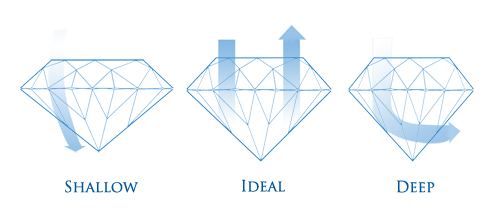
Diamond anatomy
Grading reports use a specific vocabulary for the parts of a stone. These are the terms worth knowing.
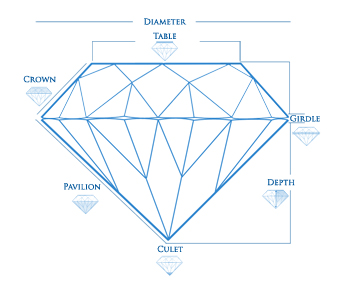
- Table
- The large flat facet on top, and the main window for light.
- Crown
- The upper portion, from the table down to the girdle.
- Girdle
- The narrow band around the widest point, where prongs grip.
- Pavilion
- The lower cone, which reflects light back up.
- Culet
- The point or tiny facet at the very bottom.
- Depth
- Table to culet, given as a percentage of the diameter.
- Diameter
- The width across the girdle: the size you actually see.
The cut grade scale
GIA grades round brilliants on five levels. IGI uses the same five for round diamonds.
| Grade | What it means | Our recommendation |
|---|---|---|
| Excellent | Maximum light return; the proportions are right | Buy this |
| Very Good | Very close to Excellent, and hard to tell apart by eye | A sensible way to save |
| Good | Noticeably less lively, though still attractive | Only if budget demands it |
| Fair | Visibly dull compared with the grades above | Avoid |
| Poor | Substantial light leakage; looks lifeless | Avoid |
The numbers behind the grade
If you like to check the report yourself, these are the ranges most commonly associated with top-performing round brilliants. Treat them as a sanity check rather than a rule: the overall grade accounts for how the proportions work together.
| Measurement | Typical range for a top cut | What goes wrong outside it |
|---|---|---|
| Table % | 54 – 58% | Too large loses fire; too small loses brilliance |
| Depth % | 59 – 62.5% | Too deep hides weight below the girdle; too shallow leaks light |
| Girdle | Thin to slightly thick | Extremely thin chips easily; extremely thick wastes weight |
| Polish & symmetry | Excellent or Very Good | Poor finish scatters light and dulls the surface |
| Culet | None or very small | A large culet shows as a dark spot through the table |
You may also see hearts and arrows advertised: a pattern visible under a special viewer that indicates exceptional optical symmetry. It is a genuine mark of precision cutting, and it carries a premium. It is not a requirement for a beautiful stone.
Why fancy shapes have no cut grade
This surprises most buyers: only round brilliants receive a cut grade from the major laboratories. There is no internationally accepted system for grading the light performance of ovals, pears, emeralds, or any other fancy shape.
Reports on fancy shapes still give polish and symmetry grades, plus the measurements, but the overall “how well does this sparkle” verdict is absent.
Cut matters just as much in lab-grown
A lab-grown diamond is still a diamond crystal that a human being has to cut, and it is graded on the same cut scale by the same laboratories. Because lab-grown stones cost roughly 40–60% less than natural for comparable specs, there is rarely any reason to compromise: buy an Excellent cut and put the savings into carat weight instead. See our lab-grown diamond guide, or filter our inventory by cut grade.
See it on real stones
Browse IGI-certified lab-grown diamonds by shape, carat, color, clarity and cut, at roughly 40–60% less than comparable natural stones.
More on diamonds: The 4Cs, Color, Clarity, Carat weight, Shapes, Inclusions, Certificates, and Conflict-free.