Diamond Education
Diamond Carat
Carat is a measure of weight, not size, and the difference between those two things is worth real money.
By 25karats · Updated 2026 · 6 minute read
One carat is exactly 0.2 grams, or 200 milligrams. Each carat divides into 100 points, so a 0.75-carat diamond is a “75-pointer” in the trade.
The word comes from the carob seed, whose pods are unusually consistent in weight and were used as counterweights by ancient traders. The metric carat of 0.2 grams was adopted in the United States in 1913, and internationally soon after.
Weight is not size
Two one-carat diamonds can look noticeably different on the hand. Carat measures how much the stone weighs; what you see is its diameter face-up.
Weight hidden below the girdle, in an over-deep pavilion or a thick girdle, is weight you paid for and nobody can see. This is the most common way to overpay for carat.

Carat weight to millimeter size
For a well-proportioned round brilliant, these are the approximate face-up diameters. Actual measurements vary with cut, so always check the report.
| Carat | Approx. diameter | Notes |
|---|---|---|
| 0.25 ct | ~4.1 mm | Common for accent stones and delicate bands |
| 0.50 ct | ~5.2 mm | A clear presence without dominating the hand |
| 0.75 ct | ~5.8 mm | A genuine value point between the magic numbers |
| 1.00 ct | ~6.5 mm | The most requested engagement ring weight |
| 1.50 ct | ~7.4 mm | Substantially larger; needs a well-scaled setting |
| 2.00 ct | ~8.2 mm | Unmistakably large; color and clarity show more |
| 3.00 ct | ~9.4 mm | Statement scale |
Note how slowly the diameter grows. Doubling the weight from one carat to two adds only about 26% to the width, because weight scales with volume in three dimensions. This is why a two-carat diamond does not look twice as big, and why the jump in price feels disproportionate to the jump in appearance.
Why price rises faster than weight
Diamond prices do not scale linearly. Larger rough is rarer, and more of it is lost in cutting, so the price per carat climbs as the weight climbs. A two-carat diamond costs considerably more than twice a comparable one-carat stone, because you are paying a higher rate on every carat.
Buying just under a magic size is the single easiest way to save on a diamond without compromising anything you can see.
How to look bigger for the same weight
Choose an elongated shape
Marquise, pear and oval spread their weight across a wider face. A 1 ct oval reads considerably larger than a 1 ct round.
Buy just under a magic size
0.90 instead of 1.00, or 1.90 instead of 2.00. A fraction of a millimeter smaller, meaningfully cheaper.
Check the diameter, not the weight
Two stones at the same carat can differ by 0.3 mm face-up. The report gives you the number, so use it.
Use a halo setting
A ring of small accent stones can make a center stone read a half carat larger than it is, for a fraction of the cost.
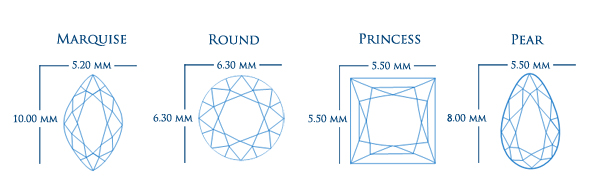
Carat is one of four factors, and the only one that is purely about quantity. A smaller stone with an excellent cut will outshine a larger dull one every time.
Carat is where lab-grown changes everything
Of the 4Cs, carat is the one where the lab-grown price difference is most dramatic, because the price gap widens as stones get larger. A budget that buys a well-cut 0.7-carat natural diamond will generally buy a lab-grown stone of two carats or more at higher color and clarity grades. If size is what you want, this is the lever. See our lab-grown diamond guide, or browse by carat weight.
See it on real stones
Browse IGI-certified lab-grown diamonds by shape, carat, color, clarity and cut, at roughly 40–60% less than comparable natural stones.
More on diamonds: The 4Cs, Cut, Color, Clarity, Shapes, Inclusions, Certificates, and Conflict-free.