Diamond Education
The 4Cs of Diamonds
Cut, color, clarity and carat: the universal grading standard. They are not equally important, and knowing the order is what separates a good buy from an expensive one.
By 25karats · Updated 2026 · 7 minute read
GIA created the 4Cs in the 1950s to give the diamond trade a common language. Before it, “quality” meant whatever the seller said it meant.
The system works, but it is often presented as four equal dials. They are not equal. Treating them as if they were is the most reliable way to spend more and get less.
Ranked, for a fixed budget
| Priority | C | What to buy | Why |
|---|---|---|---|
| 1 | Cut | Excellent, or Very Good | Decides sparkle entirely; a dull stone stays dull |
| 2 | Carat | Just under a magic size | The most visible attribute after sparkle, and where price jumps |
| 3 | Color | G–H in white metal, J–K in yellow gold | Invisible once set, if matched to the metal |
| 4 | Clarity | VS2, or an eye-clean SI1 | Graded at 10x magnification; worn at arm's length |
This ordering assumes a budget with a ceiling, which is nearly everyone. If the budget is genuinely open, buy the best of everything, but even then, cut first.
The four in brief
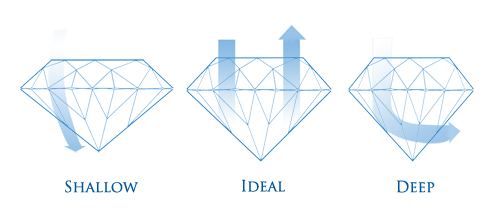
Cut
How well the facets are proportioned and finished. Graded Excellent to Poor for round diamonds; fancy shapes get no cut grade at all, so you have to judge those yourself.
Read the cut guide
Color
How little color a white diamond has, from D (colorless) to Z (light yellow). The grade you need depends on the metal you set it in, not on some absolute standard.
Read the color guide
Clarity
Internal inclusions and surface blemishes, graded FL to I3 under 10x magnification. What matters in practice is whether anything is visible without magnification.
Read the clarity guide
Carat
Weight, not size: one carat is 0.2 grams. Two stones of identical weight can differ noticeably in face-up diameter depending on how they were cut.
Read the carat guideThe fifth C: certification
A grading report from an independent laboratory is what turns the other four Cs from claims into facts. Without one you are trusting the seller’s opinion of their own merchandise.
- GIA and IGI are the reports that matter. Both are independent and widely respected.
- For lab-grown diamonds, look for IGI specifically. Since October 1, 2025, GIA no longer issues full color and clarity grades for lab-grown stones, it describes them as “Premium” or “Standard” instead. IGI still grades the full 4Cs, which is why IGI reports have become the standard for lab-grown.
- Treat in-house grading with caution. A report written by the seller is not independent, and such grades commonly run one to two levels more generous than a laboratory’s.
More detail in our guide to diamond certificates.
What the 4Cs leave out
The grading system is deliberately narrow. Three things it does not capture are worth your attention:
Shape
Round, oval, emerald, pear. Not a C, but the decision that changes the look of the ring most, and one that moves the price by up to 40%. See our diamond shapes guide.
Fluorescence
Listed on reports but not part of the 4Cs. It usually lowers the price, and on a near-colorless stone it can make the diamond face up whiter. One of the few remaining bargains, covered in our color guide.
Origin
Whether a diamond was mined or grown in a laboratory sits outside the 4Cs entirely, yet it affects price more than any grade does, roughly 40–60% for comparable specs.
How lab-grown changes the trade-offs
The 4Cs apply identically to lab-grown diamonds, same scales, same laboratories. What changes is that the compromises largely dissolve. At natural prices most buyers have to give something up; at lab-grown prices it is entirely reasonable to take an Excellent cut, a G color, a VS clarity, and the carat weight you actually wanted, all at once. See our lab-grown diamond guide, or filter our inventory by all four Cs.
See it on real stones
Browse IGI-certified lab-grown diamonds by shape, carat, color, clarity and cut, at roughly 40–60% less than comparable natural stones.
More on diamonds: Cut, Color, Clarity, Carat weight, Shapes, Inclusions, Certificates, and Conflict-free.