Jewelry Education
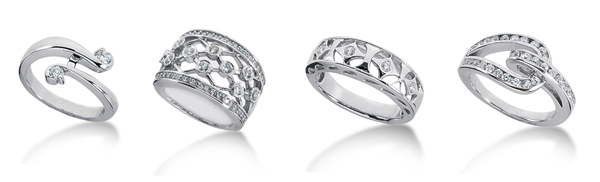
Right Hand Rings
A ring that answers to nobody but you, and the one category where the practical questions of finger, size, and setting matter more than the symbolism.
By 25karats · Updated 2026 · 6 minute read
A right hand ring is any ring worn for its own sake rather than to mark a relationship. The term describes intent, not a style. What unites the category is that nobody is going to ask what it means.
That freedom is genuinely useful. But because the right hand is the hand most people actually use, it comes with practical constraints that a left-hand engagement ring never faces, and those get almost no attention.
Which finger
There is no convention, so choose by visibility and by how much the ring will get in your way.
| Finger | How it reads | Practical notes |
|---|---|---|
| Index | Bold and deliberate; the most visible placement | Catches on things most; favor a low profile |
| Middle | Neutral, with no symbolic baggage at all | The widest finger, so it carries substantial designs well |
| Ring | Mirrors an engagement ring, read carefully abroad | Sits comfortably; least likely to interfere with your grip |
| Pinky | Carries the signet tradition; understated but distinctive | Smallest finger, so keep the scale down and the fit exact |
Your right hand is not the same size as your left
This is the most commonly skipped step, and it is the one that decides whether the ring gets worn.
Your dominant hand is typically about half a size larger than the other, because those muscles and joints do more work. Most people are right-handed, so a right hand ring usually needs to be half a size up from the equivalent finger on the left.
- Measure the actual finger on the actual hand. Never size a right hand ring from a ring worn on the left.
- Measure at the end of a normal day, at normal room temperature. Fingers swell with heat, salt, and exercise, and shrink in cold.
- Size in the width you are buying. A wide band needs roughly half a size more than a narrow one, so a bold right hand ring can be a full size up from a thin left-hand band.
- Check it can be resized. Plain and lightly set designs resize readily; eternity styles and rings with patterning around the full circumference often cannot.
Measure the right hand specifically
We’ll mail a free reusable ring sizer, or measure at home with our ring size guide and conversion chart.
The dominant hand takes the damage
An engagement ring on the left hand of a right-handed person lives a relatively sheltered life. Move the same ring to the right hand and it meets door handles, gym equipment, keyboards, steering wheels, and grocery bags several times more often.
That changes what you should buy:
Favor protective settings
Bezel and flush settings shield a stone's girdle completely. High prong settings look beautiful and snag constantly on the hand you actually use.
Keep the profile low
The lower a ring sits, the less it catches. This matters far more on the right hand than most people expect before they wear one.
Choose a hard stone
Sapphire and ruby at Mohs 9 and diamond at 10 handle daily knocks. Emerald, opal, and tanzanite are better suited to a left hand or occasional wear.
Mind the metal
14K gold holds its shape better than 18K; platinum keeps its weight but shows a patina. Either beats a thin, hollow band on a working hand.
For the full comparison on stone durability, see our gemstone guides; for metals, our precious metals guide.
Styles that suit the right hand
Because a right hand ring carries no obligation to look like anything, it is the natural home for designs that would be unconventional as an engagement ring.
Cocktail and statement rings
Large, deliberately eye-catching designs: the original right hand ring. Best on the middle or index finger, where there is room for the scale.
Cluster and halo designs
Many small stones read as more presence per dollar than one larger stone, and they sit lower: a practical advantage on the working hand.
Colored gemstone rings
Sapphire, ruby, and other colored stones are unmistakably not engagement rings, which is often exactly the point. Birthstones make the piece personal.
Stackable bands
Two or three narrow bands worn together, added to over time. Flexible, low-profile, and the easiest way to build a look gradually rather than in one purchase.
Signet rings
A centuries-old tradition, worn on the pinky or index finger. Engravable, entirely genderless, and the most durable option on this list.
Wearing one alongside an engagement ring
Putting a statement ring on the other hand is the point, it gets room to be seen without competing with a ring that already has a job.
Matching the metal color across both hands is the easy way to make everything look considered rather than accumulated. Mixing metals works too, but it reads better when it is clearly deliberate, repeated on both hands rather than happening once.
Frequently asked questions
Is my right hand ring size the same as my left?
Usually not. Your dominant hand is typically about half a size larger. Measure the specific finger on the specific hand rather than assuming sizes transfer.
Does a ring on the right hand mean you are not married?
Not everywhere. In much of Northern and Eastern Europe the wedding ring is traditionally worn on the right hand, so a plain band there will be read as a wedding ring.
Can a right hand ring be a diamond ring?
Certainly, and it commonly is. To keep it from reading as an engagement ring, avoid the single-raised-stone solitaire silhouette, clusters, bands, three-stone arrangements set low, and colored center stones all sidestep the association.
What should a right hand ring cost?
There is no convention, which is one of the pleasures of the category. Spend what suits you. If you want the ring to last, put the budget into a solid setting and a hard stone rather than maximum carat weight in a thin mounting.
Can I move an heirloom ring to my right hand?
Often yes, and it is a good way to wear a piece that doesn’t suit your left hand. Check the size against your dominant hand first, and have the setting inspected, older prongs wear thin, and the right hand is the harder posting.
Find your right hand ring
Browse our fashion and right hand rings, or talk through stones, settings, and sizing with a jewelry consultant.