Wedding Band Education
How to Choose Matching Wedding Bands
Buying a pair is a different problem from buying a ring. This guide covers the four degrees of matching, how to pair widths and metals, working around an engagement ring, sizing two very different hands, and what a set should cost.
By 25karats · Updated 2026 · 10 minute read
Almost every wedding ring guide is written about one ring. A matching set is a harder problem, because you are not choosing a ring you like, you are designing a pair that has to work on two different hands, in two different sizes, through two different daily lives, for decades. And on one of those hands, an engagement ring is already there.
That is why so many couples order an identical pair and quietly regret it. The rings that looked matched in the photograph don’t look matched on the hand, the narrower one sits crooked against the engagement ring, or one of them is scratched dull while the other still shines. None of that is bad luck. It is predictable, and every bit of it is avoidable if you make the decisions in the right order. This guide walks through that order.
Step 1
Decide how much matching you actually want
“Matching” is not one thing. It runs along a spectrum, and naming where you want to sit is the single most useful decision you can make before you look at a single ring.
| Degree | What the pair shares | Best when | The trade-off |
|---|---|---|---|
| Identical | The same design, width, metal, and finish | Neither of you wears an engagement ring, and your hands are similar in scale | One width rarely flatters two hands; the smaller hand usually loses |
| Mirrored | One design, scaled into two widths | You want an unmistakable pair without forcing one width on both | Fine detail such as milgrain or engraving may not scale down cleanly |
| Coordinated | Metal, color, and finish, but two different designs | One band must sit against an engagement ring, or your styles genuinely differ | Requires more judgment; two “nice” rings are not automatically a set |
| Complementary | A deliberate contrast, tied together by one shared element | You want personal rings and a private connection rather than a visible pair | Reads as two rings unless the shared element is genuinely consistent |
Our own catalog reflects this. Of more than 1,500 wedding band designs, over 300 are built and sold specifically as His & Hers matching sets, and the large majority of them are mirrored or coordinated rather than strictly identical.
Step 2
Start with the engagement ring, not with the pair
If one of you wears an engagement ring, it is the fixed point in this decision. Everything else moves around it. Choose the pair first and you will discover the constraint after the rings are made, which is the worst possible time.
Three things about the engagement ring drive the whole set:
- Its metal color sets the pair’s metal color. A wedding band sits against the engagement ring all day. If they are not the same color, that difference is what people see first, and the two rings will rub, so mixing metals of different hardness accelerates wear on the softer one.
- Its profile decides whether a straight band can sit flush. A low, flat setting takes almost any band. A high solitaire, a halo, or a design with stones curving down the shoulders usually leaves a visible gap, which means a contoured or notched band, not a straight one.
- Its detail level sets the ceiling for the wedding band. A pavé or heavily detailed engagement ring is usually best paired with a plain or lightly set band. Two ornate rings on one finger compete, and the engagement ring loses.
This is the single most common reason a matching set gets sent back. It is also the easiest to avoid, because a made-to-order workshop can contour a band to a specific engagement ring, something fixed inventory simply cannot do.
Step 3
Pair the widths by visual weight, not by millimeters
Here is the counterintuitive part. Two bands of the same width usually look mismatched, and two bands of different widths usually look like a set.
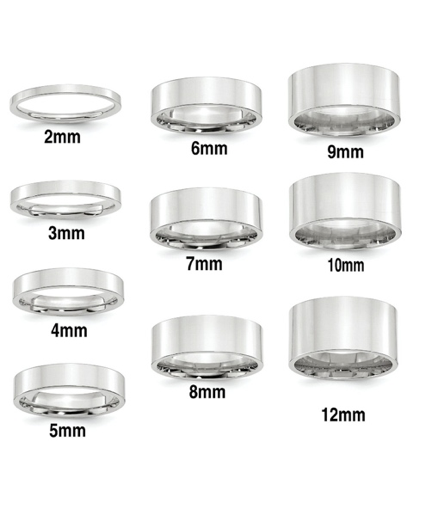
The reason is that width is read relative to the finger it sits on. A 4 mm band covers roughly a third of a slim finger and barely a fifth of a broad one. The eye compares proportions, not measurements. Matching the ratio is what makes a pair look intentional.
| If the wider band is | Pair it with | The look |
|---|---|---|
| 4 mm | 2 – 2.5 mm | Understated; both rings stay light on the hand |
| 5 mm | 2.5 – 3 mm | The most common balance, and the safest default |
| 6 mm | 3 – 4 mm | Substantial pair; needs a hand with some breadth to carry it |
| 7 – 8 mm | 4 – 5 mm | Bold and clearly matched; check knuckle clearance on both |
Roughly, aim for the narrower band to be half to two-thirds the width of the wider one. Inside that range a pair reads as matched almost regardless of design.
Thickness matters too, and gets ignored. A band thinner than about 1.5 mm can go out of round under everyday pressure, and thin rings on active hands are the most common repair we see. Keep both rings at 1.6–2.0 mm and neither will bend.
Step 4
Match the metal, and understand why it matters more for a pair
For a single ring, metal is mostly a look-and-budget decision. For a pair, it also determines whether the two rings stay matched.
| Metal | Relative hardness | How it ages | In a matched pair |
|---|---|---|---|
| 10K gold | Hardest gold | Holds a polish well; paler color | Pairs cleanly with 10K; noticeably paler beside 18K |
| 14K gold | Medium | The best balance of color and wear | The default for sets; both rings age at the same rate |
| 18K gold | Softer | Richest color; marks more readily | Fine as a pair; avoid pairing 18K against platinum |
| Platinum | Dense, develops a patina | Displaces rather than loses metal; never needs replating | Pair platinum with platinum; it will out-wear any gold beside it |
| Palladium | Similar to platinum, lighter | Naturally white, no replating | Good when one partner dislikes the weight of platinum |
Two failure modes are specific to buying a pair:
- Mixed hardness wears unevenly. If one ring is platinum and the other is 18K gold, the gold band takes the damage where they meet a partner’s hand, gets caught, or knocks against things. Within a couple of years the pair no longer looks like a pair.
- “Same metal” from two sources is not the same metal. White gold alloys and rhodium plating recipes differ between workshops. Two rings both honestly described as 14K white gold can sit visibly different in tone, and the difference sharpens as the plating wears. Buying both rings from one maker, cast from the same alloy, is the only reliable way to get a true color match.
If you want the full comparison of purity, alloys, and color, see our gold education guide and our gold vs. platinum comparison.
Step 5
Choose a finish, knowing it is really a maintenance decision
Finish is where matched pairs drift apart fastest, because the two of you do not use your hands the same way.
- High polish shows every fine scratch, but scratches blend into an even soft sheen over time. It is forgiving in the long run and unforgiving in the first month.
- Matte or satin hides small marks beautifully, but a hands-on job will burnish it back toward shiny within a year: usually in patches.
- Hammered and textured finishes hide wear best of all, because the surface is already irregular. They are the most practical choice for hard-working hands.
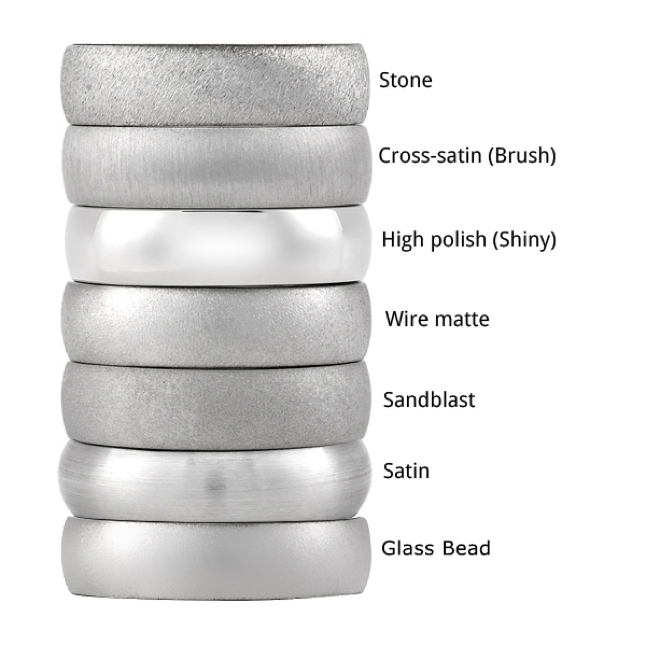
A combination finish: a satin center with polished edges, for example, is a useful matching device in its own right. Two different designs sharing the same combination finish read as a set immediately.
Step 6
Size two hands, not one order
A set is only as good as its worse fit, and there are more ways to get this wrong with two rings than with one.
- Size in the width you are actually buying. A wide band needs roughly half a size more than a narrow one, so a mirrored pair in 6 mm and 3 mm cannot be sized from the same measurement. Use a sizer in each ring’s intended width.
- Comfort-fit and standard-fit size differently. Comfort-fit bands are domed inside and pass the knuckle more easily, which often means going down a size compared with a flat interior. If the two rings use different profiles, size them independently.
- Fingers move, and not equally. Size changes with heat, cold, salt, exercise, and time of day. Measure both hands at the end of a normal day at normal room temperature, not first thing in the morning and not after a workout.
- Check resizability before you fall in love. Plain gold and platinum bands resize readily. Eternity bands set all the way around, and bands with patterning or engraving that runs the full circumference, often cannot be resized at all, which makes getting the size right the first time non-negotiable.
Order two sizers, not one
We’ll mail a free reusable ring sizer, or measure at home today with our ring size guide and conversion chart.
Step 7
Run the pair through both of your lives
The ring that suits your life and the ring that suits your partner’s may not be the same ring. This is the honest argument for coordinating rather than matching identically.
Hands-on trades and manual work
A low-profile band with a hammered or textured finish, in 14K or 10K gold. Skip raised stones and sharp edges. Many people in this group keep the ring off during work entirely, which is a legitimate answer.
Healthcare, food service, frequent hand washing
Comfort-fit with a smooth interior, no crevices for soap and residue to collect, and stones set flush rather than raised. Easy to clean matters more than it sounds.
Gym, climbing, weights
Weight-bearing grip is what causes ring injuries and bent bands. Choose a thicker cross-section over a thin one, and take the ring off for barbell work regardless.
Desk work and light wear
The widest range of options. This is the hand that can carry a delicate design, a softer 18K alloy, or a high-polish finish and still look new for years.
If the two answers point in different directions, keep the metal and finish shared, and let the designs differ. That is a coordinated set, and it will be worn more than an identical set that only one of you finds comfortable.
Step 8
Engraving: the match nobody else sees
When two rings can’t look alike, whether through different widths, different designs, or different demands, engraving is what makes them a pair anyway. It is the least expensive and most personal matching device available, and it is usually free.
Two practical notes. Narrow bands limit character count, so check the limit for the narrower ring and design the phrase around it. And engraved rings are frequently non-returnable everywhere, which is another reason to confirm sizing before the rings are personalized.
Step 9
Budget the pair, not the ring
Matching sets generally land between $600 and $6,000, with plain gold pairs at the low end and diamond-set or platinum pairs at the high end. Three things surprise people:
- The pair does not split evenly. Precious metal is sold by weight, so the wider band usually costs more: often noticeably more, even when it is the plainer of the two. A 6 mm band can contain roughly twice the gold of a 3 mm band in the same design.
- Buying as a set is where the savings are. One order, one shipment, one casting run, and one point of contact for future service. Sets are also priced as sets, which is not true when you assemble a pair from two retailers.
- Plain bands expose the seller. A plain band is almost entirely metal and labor, so the price difference between two sellers is mostly markup structure. That makes plain matching sets the single best category for comparing factory-direct pricing against traditional retail.
If the budget is tight, the highest-value move is to keep both rings in 14K gold and put the difference into width and thickness rather than into stones. Metal is what you feel every day; a small accent diamond is not.
Step 10
Give a set more time than a single ring
A pair is finished when the slower of the two rings is finished, and every step has to happen twice. Three months is comfortable; six weeks is tight.
| Time before the wedding | What to do |
|---|---|
| 12 weeks | Agree on your degree of matching, and order sizers for both hands |
| 10 weeks | Settle metal and finish; test a straight band against the engagement ring |
| 8 weeks | Place the order, including engraving text for both rings |
| 4 weeks | Rings arrive; wear each for several days across different times of day |
| 2 weeks | Resize if needed, and put the pair somewhere you will not have to search for it |
Made-to-order rings typically take around two weeks to craft, and custom work longer. Building in a resize window is the step couples skip and then regret.
Five mistakes we see most often
- Choosing the pair before checking the engagement ring. The band that can’t sit flush is the number one return.
- Ordering identical widths. The same number on two different hands rarely looks like the same ring.
- Buying the two rings from two places. Metal tone, plating, and finish will not match, and no one can fix it afterward.
- Sizing once and applying it to both rings. Width and interior profile both change the size.
- Choosing a set that only one of you would have chosen. The compromise ring gets left in a drawer, and then it isn’t a matching set at all.
Where to look, by degree of matching
His & Hers sets
Pairs designed together as sets, already scaled into two widths. The shortest path to a mirrored or coordinated pair.
BrowsePlain & classic bands
The most flexible starting point for a coordinated pair: pick one metal and finish, then two widths that suit each hand.
BrowseDiamond bands
For pairs where one ring carries stones and the other doesn't: a common and well-balanced arrangement.
BrowseHandmade bands
Worked by hand, which makes the metal denser and the ring more durable. Well suited to a hard-working hand in a coordinated set.
BrowseFancy & designer bands
Distinctive designs for a complementary pair, tied together by a shared metal and finish.
BrowseCustomizable bands
Specify width, metal, color, profile, and finish per ring: the most direct way to build a set that fits both hands.
BrowseIf you are still deciding on the fundamentals of a single band (metals, karats, styles, and budget), start with our wedding ring buying guide, then come back here to pair it.
The matching-set checklist
Frequently asked questions
Do wedding bands have to match?
No. Matching is a choice, not a rule. Most couples are happiest somewhere in the middle of the spectrum, sharing a metal and finish, differing in width and often in design, because an identical pair rarely suits two very different hands.
Should matching bands be the same width?
Usually not. Aim for the narrower ring to be about half to two-thirds the width of the wider one. Two identical widths often look mismatched, because the same millimeter measurement occupies a very different share of each finger.
Can we mix metals in a matching set?
You can, but there are two costs. Metals of different hardness wear at different rates, so the softer ring shows damage first. And a wedding band that sits against an engagement ring of a different color makes that difference the most visible thing on the hand. Mixing tones works best when it is clearly deliberate: a two-tone design used in both rings, for instance.
What if one of us already has a wedding band?
Treat the existing ring as the fixed point. Match its metal color and karat, then choose a second band that coordinates in finish and proportion rather than trying to reproduce it exactly. A workshop that makes to order can match an older band far more closely than a fixed-inventory retailer.
How much does a matching wedding band set cost?
Typically $600 to $6,000. Plain gold pairs sit at the low end, diamond-set and platinum pairs at the high end. Expect the wider ring to cost more, since precious metal is priced by weight.
When should we order our matching bands?
About three months before the wedding. A set needs more lead time than a single ring, because both rings have to be sized, made, engraved and, if necessary, resized before the date, and the pair is only ready when the slower of the two is finished.
Can a matching set be resized later?
Plain gold and platinum bands generally can. Eternity bands set all the way around, and rings with a pattern running the full circumference, often cannot. Ask about the resizing policy for both rings before ordering. At 25karats, resizing is done in-house in the same workshop that made the rings.
Ready to choose your pair?
Browse more than 300 His & Hers matching-set designs, made to order in New York City’s Diamond District, or talk through widths, metals, and engagement ring fit with a jewelry consultant.