Gemstones
Emerald
The one classic gemstone where inclusions are expected rather than penalized, and the one that asks the most of you in return.
Emerald is the green variety of beryl, colored by chromium or vanadium. The name reaches English through Old French esmeraude and Latin smaragdus, from a Greek word for green gemstone.
It is the most demanding of the classic three to buy well, because almost everything that would count as a defect in a sapphire is normal in an emerald.
Inclusions are the norm, not the exception
Virtually every natural emerald contains visible inclusions, fissures, mineral crystals, and fluid pockets. The trade calls the resulting pattern jardin, French for garden.
This is a genuine difference in grading convention. An eye-visible inclusion that would drop a sapphire several clarity grades is simply expected in an emerald, and a flawless one at a normal price should raise your suspicion rather than your pulse.
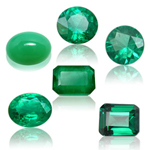
Why the “emerald cut” is named after the stone
The rectangular step cut with clipped corners was developed for emeralds specifically, and for two practical reasons rather than aesthetic ones.
- Corners are where stones chip. Emerald is brittle and often fissured, so cutting the sharp corners away removes the most vulnerable points and gives a setting’s prongs something safer to hold.
- Broad flat facets suit color over sparkle. Emerald’s appeal is the depth and evenness of its green. Large step facets show that off, where the many small facets of a brilliant cut would break the color into flashes.
The cut has since been applied to diamonds and every other gem, but the shape exists because of what emerald is.
Color: the dominant value factor
As with ruby, color carries most of the value. The ideal is a pure, vivid green, medium to medium-dark in tone, with no brown or grey dulling it. A slight blue secondary hue is widely accepted and often admired; yellow secondary tones are less prized.
| Source | Typical character |
|---|---|
| Colombia | The historic benchmark: a pure, warm, slightly yellowish-green, often with a soft glow |
| Zambia | A major modern source; typically bluer-green, often cleaner, and frequently better value |
| Brazil | Wide range of quality, from lighter commercial material to fine stones |
| Ethiopia, Afghanistan, Russia | Smaller and more variable production, occasionally exceptional |
There is no single “best” origin, only different characters at different prices. To compare stones methodically, use our gemstone color guide.
Oiling: what it is and why it matters
Nearly all emeralds on the market are treated with oil or resin. Cedarwood oil, whose optical properties closely match beryl’s, seeps into surface-reaching fissures and makes them far less visible. The practice is centuries old and disclosed as standard.
What you need to know is the degree, which laboratories grade roughly as none, minor, moderate, or significant. It has a large effect on price: a stone graded “no oil” can be worth several times an otherwise identical one graded “significant.”
How to care for an emerald
At 7.5–8 on the Mohs scale emerald is reasonably hard, but hardness is not the issue, its fissures make it comparatively brittle. Treat it as the most delicate of the classic gemstones.
- Never use an ultrasonic or steam cleaner. Both can drive oil out of the fissures and can worsen an existing fracture. Warm water, mild soap, and a soft brush is the whole routine.
- Keep it away from heat and solvents. That includes leaving a ring on through household cleaning, and it includes jeweler’s heat, always tell anyone doing repair work that a stone is emerald.
- Choose a protective setting. Bezels and half-bezels shield the girdle and corners far better than exposed prongs.
- Think twice about an everyday ring. Emerald is a superb choice for earrings, pendants, and occasional rings. For a ring worn through manual work, sapphire at Mohs 9 is the more practical stone.
May's birthstone
Emerald is the birthstone for May and the traditional gift for 20th and 35th wedding anniversaries.
The Mughal Emerald
A famous 217.80-carat Colombian emerald inscribed with prayer, dated 1695, among the most celebrated historic emeralds.
Lab-grown alternatives
Synthetic emeralds are widely available, typically cleaner and far cheaper than natural. They must always be disclosed.
Set it in the right metal
Yellow gold flatters a warm Colombian green; white metals suit a cooler, bluer Zambian stone.
Looking for an emerald piece?
Browse our color stone rings, or talk to a consultant about a protective setting and what treatment disclosure to expect.