Wedding Band Education
How to Buy a Wedding Ring
The ultimate guide to choosing a band you’ll love for decades: metals, styles, width and fit, finishes, and what to budget.
By 25karats · Updated 2026 · 7 minute read
You’re engaged, the date is set, and now comes one of the few wedding purchases that outlasts the day itself. Unlike the venue or the flowers, a wedding ring is worn every day for a lifetime, which makes it worth choosing deliberately.
This guide walks through every decision in order: the metal, the style, the width and fit, the finish, and the budget. By the end you’ll know exactly what to ask for, whether you buy from us or anywhere else.
Step 1
Choose your metal
The metal determines how the ring looks, wears, and ages. These are the five you’ll encounter:
Yellow gold
The traditional choice: warm, instantly recognizable, and easy to repair, resize, and refinish for decades.
White gold
A modern silvery tone that pairs cleanly with diamonds. It’s rhodium-plated for brightness, so plan on replating every few years.
Rose gold
A warm pink hue from copper in the alloy, which also adds durability. Distinctive without being loud.
Platinum
Naturally white, denser and heavier than gold, and hypoallergenic. It costs more, but the color never fades or needs replating.
Palladium
Platinum’s lighter sibling: naturally white and hypoallergenic with less weight on the finger.
If you choose gold: pick a karat
| Gold | Purity | Best for |
|---|---|---|
| 14K | 58.3% | The everyday default, balancing durability, color, and price |
| 18K | 75% | Richer color and higher purity at a premium |
| 10K | 41.7% | The budget-friendly, highly durable option |
Gold remains the most popular wedding band metal, with an option for every budget. For a deeper look at purity and alloys, see our gold education guide.
Step 2
Choose your style
Wedding bands range from quiet classics to statement designs. Start with the family that fits you:
Plain bands
Elegant simplicity that puts the metal's shine and luster first. The classic choice for matching sets.
BrowseDiamond bands
Sparkle set into the band itself, from a single accent stone to a full eternity of diamonds.
BrowseHandmade bands
Artisan-crafted rings with a personal touch. Working the metal by hand makes them denser and stronger.
BrowseFancy & designer bands
Distinctive designs with unique elements, from romantic detail to architectural lines.
BrowseAntique-style bands
Designs drawn from eras past: milgrain, engraving, and craftsmanship with historical character.
BrowseReligious bands
Express shared faith through subtle or pronounced religious symbols and motifs.
BrowseDeciding whether your two bands should match? They don’t have to. Many couples coordinate the same metal color in different widths or finishes instead of buying an identical pair. Our matching wedding bands guide covers how to pair two rings that suit two different hands.
Step 3
Get the width and fit right
- Width: Women’s bands typically run 2–4 mm and men’s 4–7 mm, but comfort and proportion matter more than convention. Some designs require a minimum width.
- Thickness: A medium thickness of 1.6–2.0 mm wears comfortably and holds its shape for decades.
- Size: Finger size shifts with temperature and time of day, and wide bands (6 mm+) usually need about half a size more. Measure with a proper sizer, not string.
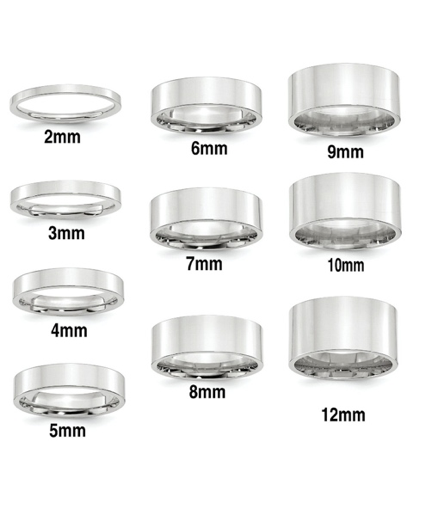
Get sized before you order
We’ll mail you a free reusable ring sizer, or use our ring size guide to measure at home today.
Step 4
Pick a finish
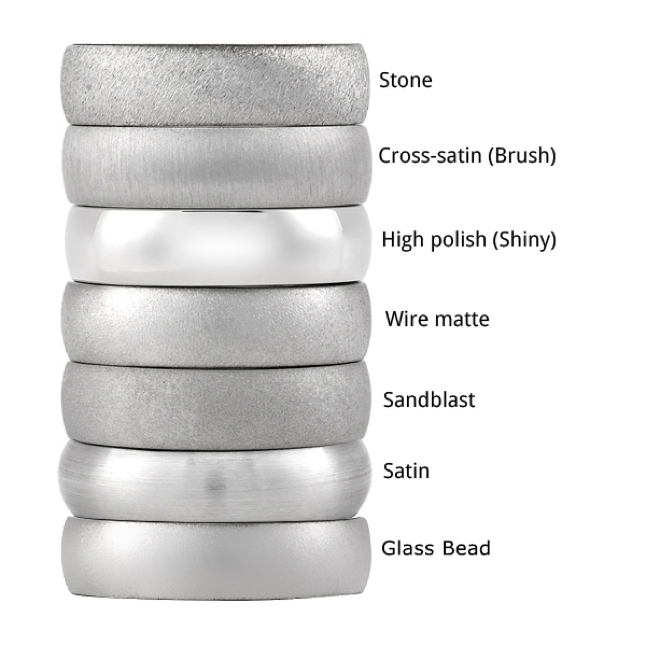
The finish gives the ring its character:
- Polished: the classic shiny, reflective surface.
- Matte / brushed: a soft, contemporary look that hides fine scratches well.
- Combinations: mixing polished and matte areas creates striking contrast on a single band.
Step 5
Set your budget
Wedding rings span roughly $150 to $25,000. Four things drive where a ring lands in that range:
- Metal type and karat. Heavier bands in higher karats or platinum contain more precious metal.
- Diamonds or gemstones, their size, quality, and certification.
- Design complexity and craftsmanship, especially handmade or custom work.
- Where you buy. Traditional retail can stack several markups between the manufacturer and you; buying factory-direct removes them.
A classic 14K gold band offers the most ring for the money, and because plain bands are mostly metal, differences in craftsmanship and markup show up clearly in the price.
Who buys the rings?
Traditionally, each partner buys the other’s band as a gesture of mutual commitment.
Frequently asked questions
How much does a wedding ring cost?
Most wedding rings fall between $150 and $25,000. The price is driven by metal type and karat, band width and weight, design complexity, and whether the ring includes diamonds or gemstones. A classic 14K gold band typically sits at the affordable end of that range.
Who traditionally buys the wedding rings?
Traditionally, each partner buys the other's band. Today many couples shop together and share the cost, especially when they manage wedding expenses jointly. There is no wrong answer; choose what fits your relationship.
When should we buy our wedding rings?
Start about three months before the wedding. That leaves time to order a free ring sizer, have made-to-order rings crafted (often around two weeks), add engraving, and handle a resize if the fit isn’t perfect.
Do our bands have to match?
No. Matching sets are a beloved tradition, but plenty of couples choose different widths, finishes, or even metals. A common middle path is coordinating the same metal color in two different widths.
Can a wedding ring be resized later?
Gold and platinum bands can generally be resized; eternity bands with stones all the way around often cannot. Ask about the resizing policy before you buy. At 25karats, resizing is done in-house in the same workshop that made the ring.
How do I keep the ring looking new?
A quick at-home cleaning every few weeks does most of the work; see our jewelry cleaning guide. Professional cleaning and inspection every six months (free for life on 25karats pieces) handles the rest.
Ready to find your rings?
Browse more than 1,500 wedding band designs made in New York City’s Diamond District, or talk through metals, widths, and custom ideas with a jewelry consultant.