Jewelry Education
How to Buy an Engagement Ring
Eight decisions, in the order they actually matter, starting with the one that has changed engagement ring budgets more than anything else in a generation.
By 25karats · Updated 2026 · 9 minute read
Most engagement ring advice was written for a market that no longer exists. It assumes the center stone is a mined diamond, that carat weight is the thing you compromise on, and that you should budget some multiple of your salary.
Lab-grown diamonds have made all three assumptions obsolete. A budget that bought a modest stone five years ago now buys a substantial one, and the first question is no longer “how much?” but “which kind of diamond?” That is where this guide starts.
Step 1
Lab-grown or natural?
Make this decision first. It affects your budget more than every other choice combined.
A lab-grown diamond is a diamond: pure crystallized carbon with the same chemical, physical, and optical properties as a mined one: the same hardness of 10 on the Mohs scale, the same brilliance and fire. The FTC recognizes them as diamonds. They pass standard diamond testers, because those measure thermal conductivity, which is identical in both. No jeweler can separate them with the naked eye or a loupe; it takes specialized laboratory instruments.
| Lab-grown | Natural | |
|---|---|---|
| Material | Crystallized carbon | Crystallized carbon, identical |
| Hardness | Mohs 10 | Mohs 10 |
| Price, comparable specs | Roughly 40–60% less | The benchmark |
| 1 carat, quality stone (2026) | About $2,000 – $3,500 | About $4,000 – $6,500 |
| Resale recovery | Often 10–40% at best, and falling | Typically 20–60% |
| Rarity | Produced to order | Geologically rare |
| Standard report | IGI | GIA or IGI |
We cover the full comparison, including how lab diamonds are grown and how to read the reports, in our lab-grown diamond guide. You can also browse our lab-grown inventory by shape, size, and grade.
Step 2
Set a budget you are comfortable with
First, discard the old rule. “Two months’ salary” was an advertising slogan from a diamond marketing campaign, not financial guidance, and it has no bearing on what a ring should cost.
Budget the stone and the setting separately, because they scale differently:
| Total budget | With a lab-grown center stone | With a natural center stone |
|---|---|---|
| $1,500 – $2,500 | Around 1 carat, good grades, simple setting | Around 0.4–0.5 carat, simple setting |
| $2,500 – $5,000 | 1.5–2.5 carats, high grades, quality setting | Around 0.7–1 carat, quality setting |
| $5,000 + | 3 carats or more, or a fancy shape and custom work | 1.25 carats or more, or a designer setting |
Settings typically run $500 to $2,500 depending on metal, complexity, and how many accent stones they carry.
Step 3
The 4Cs, and where to spend
The four grading factors are not equally important, and treating them as if they were is the most common way to overpay.
Cut, spend here
Cut governs how the stone returns light, and it is the only C that is about craftsmanship rather than the rough. A poorly cut diamond looks dull whatever its other grades. Buy Excellent or Ideal and do not compromise. See our diamond cut guide.
Clarity, buy eye-clean, not flawless
Inclusions you cannot see without magnification do not affect beauty, only price. VS2 or SI1 is typically eye-clean and costs far less than VVS or Flawless. Look at the stone, not just the grade. See our clarity guide.
Color, match it to the metal
In white gold or platinum, aim for G–H; warmth shows against a white setting. In yellow or rose gold you can comfortably go to I–J, because the metal masks it and the money is better spent elsewhere. See our color guide.
Carat, buy just under the round numbers
Prices jump at 0.50, 1.00, 1.50 and 2.00 carats because that is where demand concentrates. A 0.95-carat stone looks essentially identical to a 1.00 and costs noticeably less. See our carat guide.
One consequence of lab-grown pricing worth noting: because the stones are so much cheaper, the usual trade-offs loosen. It is entirely reasonable to buy an excellent cut, a high color, and an eye-clean clarity all at once, something that would be out of reach at most budgets in natural.
Step 4
Insist on an independent report
A grading report from an independent laboratory is what turns a seller’s description into a verifiable fact. Never buy a center stone without one.
- For lab-grown diamonds, look for IGI. As of October 1, 2025, GIA describes lab-grown stones as simply “Premium” or “Standard” rather than issuing full color and clarity grades. IGI still grades them on the complete 4Cs scale, which is why IGI reports have become the standard for lab-grown and the only practical way to compare stones like for like.
- For natural diamonds, GIA or IGI. Both are independent and widely respected.
- Check the laser inscription. Lab-grown diamonds are inscribed on the girdle with their report number and origin. That inscription, not the appearance, is how origin is identified.
- Be wary of in-house grading. A report issued by the seller is not independent, and in-house grades commonly run one to two grades more generous than a laboratory would.
Every lab-grown diamond we sell is IGI certified. More on what the reports contain in our diamond certificates guide.
Step 5
Choose a shape
Shape is the most visible decision and the most personal. It also has budget consequences: round brilliants command a premium because they waste the most rough and return the most light, while elongated shapes look larger per carat.
Round brilliant
The most brilliant shape and the most popular. Priced at a premium over every other cut.
Oval, pear, marquise
Elongated shapes look larger than their carat weight and flatter the finger. Watch for the bow-tie shadow across the center.
Emerald & Asscher
Step cuts that trade sparkle for clean, architectural flashes. They show inclusions more, so buy a higher clarity.
Princess, cushion, radiant
Square and cushioned shapes with strong brilliance, generally less expensive per carat than round.
See all ten shapes compared in our diamond shapes guide, or browse lab-grown diamonds by shape.
Step 6
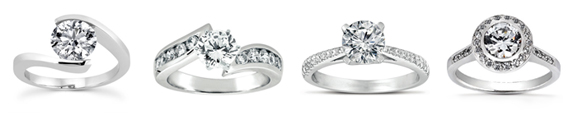
Pick a setting
- Solitaire: a single stone, nothing competing with it. The classic, and the easiest to pair with a wedding band later. Browse
- Halo, small stones encircling the center, making it read substantially larger. Excellent value for apparent size. Browse
- Three-stone, past, present, future. More presence than a solitaire without a halo’s density. Browse
- Pavé, accent stones set along the band for continuous sparkle. Browse
- Bezel: a metal rim fully surrounding the stone. The most protective option, and the right call for hands-on work or an active life.
Step 7
Choose the metal
| Metal | Why choose it | Upkeep |
|---|---|---|
| Platinum | Naturally white, hypoallergenic, the most secure prongs | None required; develops a patina |
| White gold | The platinum look at a lower price | Rhodium replating every few years |
| Yellow & rose gold | Warm tone; lets you buy a lower color grade | None required |
| Palladium | Naturally white and nickel-free, much lighter than platinum | None required |
Two things people wish they had known. First, the metal color changes which diamond color grade you need, yellow gold hides warmth, so you can save real money there. Second, look at what they already wear. Someone whose jewelry is all yellow gold will not suddenly switch to platinum for one ring.
Step 8
Get the size right, and think one ring ahead
If it is a surprise, sizing is the hardest practical problem. The reliable approaches:
- Borrow a ring they already wear on the correct finger and measure its inner diameter against our ring size conversion chart.
- Ask someone close to them. A sibling or best friend usually knows, or can find out without raising suspicion.
- Or accept a resize. Solitaires and simple settings resize easily. Eternity styles set all the way around often cannot be resized at all, check before buying.
Not sure of their size?
We’ll mail a free reusable ring sizer, or use our ring size guide to measure a borrowed ring at home.
How long it takes
A ready-to-ship setting with a stone already in inventory can be finished in days. A made-to-order or custom ring typically takes around two weeks, and a fully custom design longer. Add time for a resize if you are guessing at the size. If you have a date in mind for the proposal, start six to eight weeks out and you will not be rushed.
Frequently asked questions
Are lab-grown diamonds real diamonds?
Yes. They are pure crystallized carbon with the same chemical, physical, and optical properties as mined diamonds, recognized as diamonds by the FTC, and graded by the same independent laboratories. They will not cloud or fade: a diamond is a diamond.
Will anyone be able to tell?
Not by looking. Separating lab-grown from natural requires specialized laboratory instruments; a loupe and a standard diamond tester cannot do it. The laser inscription on the girdle and the grading report are how origin is identified.
Which of the 4Cs matters most?
Cut, by a wide margin. Buy the best cut you can afford, take an eye-clean clarity rather than a flawless one, and choose color to suit the metal.
Do lab-grown diamonds hold their value?
Generally no: often 10–40% recovery at best, and falling, against 20–60% for natural. Buy either one to wear, not as an asset.
Can I upgrade the stone later?
Often, yes. Ask about upgrade terms before you buy rather than assuming. Because lab-grown stones cost so much less, many people simply buy the size they want at the outset instead.
Should I buy a lab-grown or natural diamond engagement ring?
Choose based on your priorities. Lab-grown diamonds are chemically and optically identical to natural ones and cost roughly 40-60% less for comparable color, clarity, and cut, so the same budget buys a substantially larger or higher-grade stone. Natural diamonds offer rarity, heritage, and stronger value retention. Either way, prioritize cut, it is what makes any diamond beautiful.
How much does an engagement ring cost in 2026?
It depends far more on stone origin than on anything else. In 2026 a quality 1-carat natural diamond runs roughly $4,000 to $6,500 before the setting, while a comparable lab-grown stone runs about $2,000 to $3,500. Settings typically add $500 to $2,500. Ignore the old two-months-salary rule, it was an advertising slogan, not financial advice.
Why do lab-grown diamonds come with IGI reports rather than GIA?
As of October 1, 2025, GIA describes lab-grown diamonds as simply Premium or Standard rather than issuing full color and clarity grades. IGI continues to grade lab-grown diamonds on the full 4Cs scale, which is why IGI reports have become the standard for lab-grown stones and why comparing lab-grown diamonds is easiest with IGI reports in hand.
How do I find their ring size without asking?
Borrow a ring they already wear on the correct finger and measure its inner diameter against a conversion chart, or ask a close friend or family member. Failing that, choose a size and plan on a resize, most solitaire and simple settings resize easily, while eternity styles set all the way around often cannot be resized at all.
Start with the stone or the setting
Browse IGI-certified lab-grown diamonds by shape, size, and grade, or explore engagement ring settings made in New York City’s Diamond District.